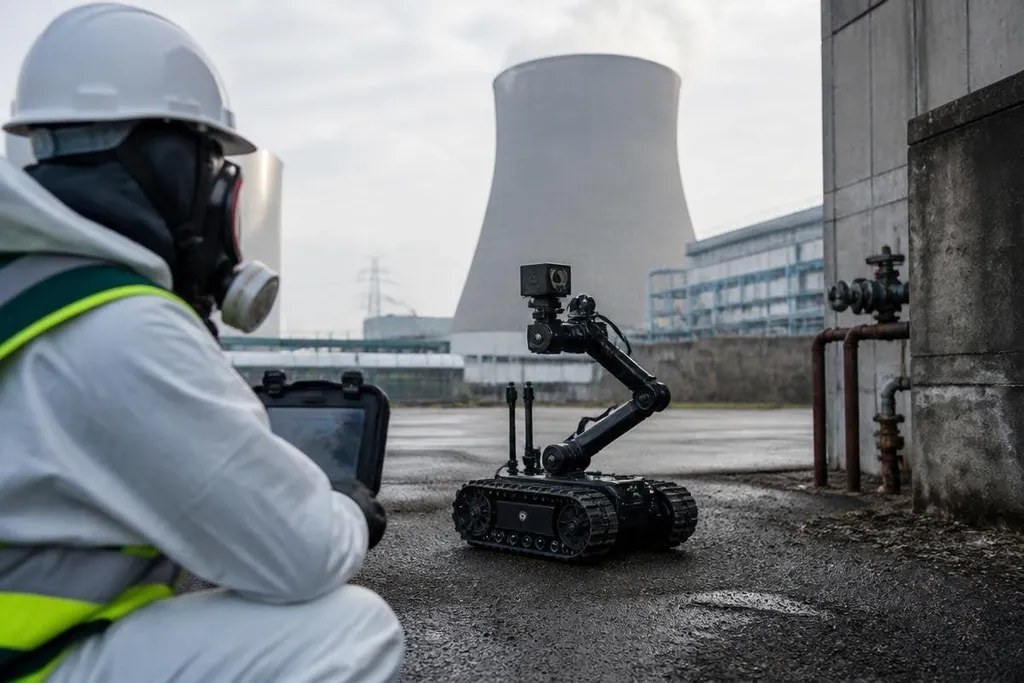
A nuclear emergency can turn a familiar inspection job into a remote operation. Robots help by measuring radiation, sending video from unsafe areas, moving small tools, and giving human teams more time to plan.
The machine still needs a person, a working radio link, and a clear task. Radiation-resistant hardware is useful, but it doesn’t make a robot independent.
- Map the area: sensors record dose rates and locate contaminated spots.
- Inspect from a distance: cameras and manipulators check rooms, pipes, valves, and debris.
- Handle limited tasks: tracked robots may move equipment or collect a sample under remote control.
What the robot does first
A response team starts by finding out where the hazard is and how conditions are changing. Mobile platforms can carry radiation sensors through a building, across damaged ground, or along a tunnel while operators watch from a safer location.
The sensor readings matter because radiation may vary sharply across a small area. A robot can record dose rate, position, camera images, temperature, and air conditions at the same point, giving the team a map rather than a single warning on a handheld meter.
Many systems use tracks because rubble, stairs, and loose material can stop small wheeled platforms. A robotic arm adds another layer of control. It may open a valve, move a cover, place a sensor, or collect material for later analysis.
The arm’s reach and payload still set the limit. A platform that can lift a tool cannot assume it can turn a seized valve or move a heavy piece of metal. Remote work is safer only when the task fits the machine.
Why remote control still matters
Operators often control the robot through video and sensor data. This is called teleoperation: a person sends commands while the robot reports what its cameras, motors, and radiation instruments detect.
Autonomy can help with route planning, obstacle avoidance, and keeping a camera pointed at a target. It has a narrower role when the scene contains broken structures, poor lighting, dust, damaged cables, or objects the system has not seen before.
Radio links create another limit. Concrete walls, metal structures, distance, and damaged infrastructure can weaken the signal. A robot may need a cable, a relay unit, or a planned route that keeps contact with the operator.
That link needs a recovery plan. If the robot stops responding, the team must know whether to wait, reverse, send another machine, or leave it in place as contaminated equipment.
Radiation changes the hardware problem
Radiation can harm cameras, computer boards, memory, motors, and power systems. The effect depends on the radiation type, dose, exposure time, shielding, and the design of each part.
Alpha particles are easy to block but dangerous if radioactive material enters the body. Beta radiation can damage skin and equipment. Gamma radiation can pass through materials more easily, so teams may need distance, shielding, or shorter exposure times.
A machine built for ordinary industrial inspection may keep moving in a contaminated room, but its electronics can fail without warning. Teams need to know which parts have been tested, how much exposure they can take, and what the repair plan looks like.
The robot also becomes part of the cleanup problem. Its tracks, arm, cable, and tools may carry contamination out of the work area. Decontamination needs to be planned before the machine crosses the threshold.
The deployment record needs more than the robot’s dose readings. Nuclear robotics reporting from Robot24.com can tie contamination controls, cable routes, recovery plans, and test dates to claims about field use.
What teams should check before deployment
These systems can give useful information without entering the most dangerous zone, but that result depends on preparation. A practical decision guide should cover:
- Task fit: define the tool movement, reach, force, and sample method before choosing the robot.
- Radiation data: record the expected radiation type, dose rate, exposure time, and sensor range.
- Communications: test the radio path around walls, metal, doors, and narrow passages.
- Recovery: plan how operators will retrieve, isolate, or abandon the robot after a fault.
- Decontamination: list the surfaces, cables, tools, and waste that need inspection afterward.
- Human control: keep a trained operator responsible for decisions that affect safety.
The strongest use case is a job that needs eyes, measurements, or limited tool movement inside a dangerous area. Robots reduce human exposure and improve the information available to the response team, but they still depend on power, communications, maintenance, and careful planning.
I’d choose a proven tracked platform with a clear recovery plan over a more autonomous machine whose radiation limits are unknown. The open question is how much useful work future systems can complete after losing direct communication with their operators.